
01 · Overview
Product context and engineering scope.
The goals, operating context, and technical decisions behind this case study.
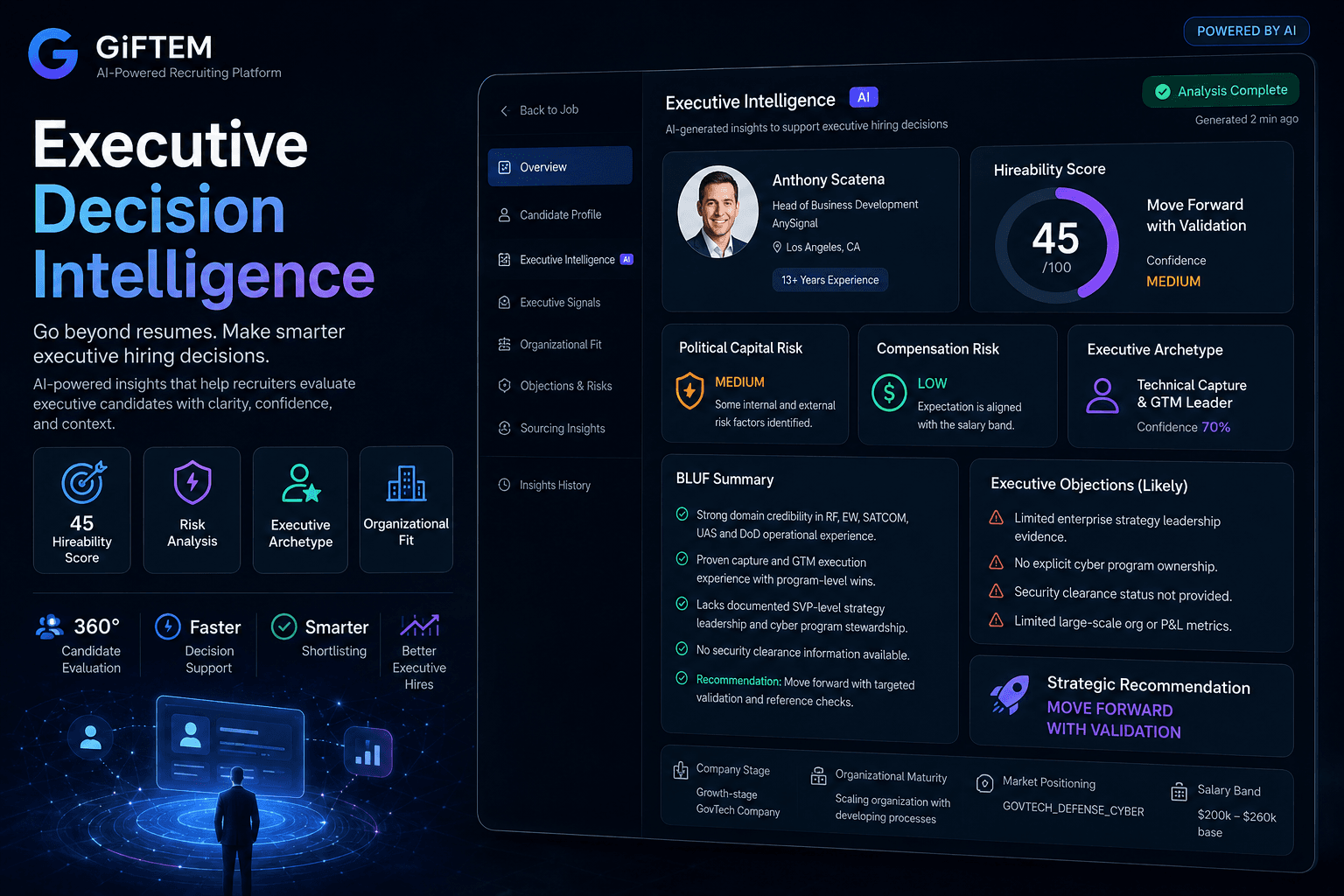
Executive Decision Intelligence helps recruiters evaluate executive-level candidates using a deeper decision-support workflow instead of relying only on traditional resume-to-job matching.
Built for GiFTEM — Shuvel Digitech
01
The feature analyzes executive hiring signals such as hireability, strategic fit, organizational alignment, compensation risk, political capital risk, leadership archetype, and role-specific validation gaps.
02
Recruiters receive a structured executive summary that helps them understand whether a candidate is worth moving forward, what risks should be validated, and what objections a hiring executive may raise.
02 · Key Contributions
What I engineered across the product.
Every original contribution preserved in sequential chapters, highlighting technical execution.
As AI Engineer / Full Stack AI Engineer at GiFTEM — Shuvel Digitech, I engineered core capabilities across the product.
3 engineering deliverables
01
Designed and implemented the Executive Decision Intelligence feature across backend services, AI workflow orchestration, candidate analysis response handling, and recruiter-facing frontend UI.
02
Built an AI-powered executive evaluation workflow that generates decision-support insights for executive-level roles based on job context, candidate background, and available hiring inputs.
03
Implemented executive-position gating logic to ensure the feature is applied only to executive-level roles such as C-suite, VP, SVP, EVP, President, Founder, Managing Director, and Head-of-function positions.
3 engineering deliverables
04
Developed structured EDI outputs including hireability score, strategic recommendation, political risk, compensation risk, confidence level, executive archetype, BLUF summary, organizational fit, and likely executive objections.
05
Added support for recruiter-provided executive context such as company stage, salary band, compensation expectation, hiring executive persona, organizational maturity, and market positioning.
06
Implemented graceful handling for missing inputs so the system can still generate useful insights while clearly communicating confidence limitations and validation requirements.
2 engineering deliverables
07
Designed the frontend Executive Intelligence tab to present complex executive assessment data in a recruiter-friendly and decision-ready format.
08
Integrated asynchronous processing patterns so executive analysis can be generated without blocking the core candidate analysis experience.
03 · Capabilities
Capabilities designed around real user needs.
The product features and system behaviors delivered by this project.
01
Executive Role Detection
Identifies whether a job is executive-level before generating Executive Decision Intelligence.
02
Hireability Scoring
Generates a role-specific hireability score that reflects how suitable an executive candidate is for the selected position.
03
Executive Archetype Classification
Classifies the candidate into an executive profile type such as GTM leader, strategy executive, capture leader, or transformation operator.
04
Political Capital Risk Analysis
Surfaces risks a recruiter or hiring leader should consider before recommending an executive candidate.
05
Compensation Risk Assessment
Compares available compensation expectations and salary-band context to identify alignment or negotiation risk.
06
BLUF Executive Summary
Provides a concise bottom-line-up-front summary with key strengths, risks, recommendation confidence, and next-step guidance.
07
Executive Objection Forecasting
Highlights likely objections or concerns a hiring executive may raise during candidate review.
08
Organizational Fit Insights
Evaluates how well the candidate may fit the company stage, operating maturity, leadership expectations, and growth context.
04 · System flow
How the system moves from input to outcome.
A stage-based connected process visualization preserving every workflow step.
Stage 01
Recruiter creates or selects an executive-level job
Stage 02
System identifies whether the role qualifies for Executive Decision Intelligence
Stage 03
Recruiter reviews or updates missing executive context inputs
Stage 04
AI evaluates the candidate against executive role expectations
Stage 05
System generates hireability, risk, archetype, and recommendation insights
Stage 06
Recruiter reviews the Executive Intelligence tab for decision support
Stage 07
Recruiter validates highlighted risks before shortlisting or moving forward
05 · Decisions
Constraints translated into engineering decisions.
The problems that shaped the product and the responses used to address them.
01
The constraint
Traditional candidate matching can identify resume alignment but may not explain whether an executive candidate is actually worth moving forward.
Engineering decision
Built an Executive Decision Intelligence layer that evaluates hireability, strategic fit, organizational alignment, executive risks, and decision-maker concerns.
02
The constraint
Executive hiring decisions require more context than standard job and candidate data can provide.
Engineering decision
Added support for recruiter-provided executive context such as company stage, salary band, hiring executive persona, organizational maturity, compensation expectation, and market positioning.
03
The constraint
Not every role should receive executive-level analysis.
Engineering decision
Implemented executive-position gating so EDI is generated only for roles that qualify as executive positions.
04
The constraint
Missing business context can reduce confidence in AI-generated executive recommendations.
Engineering decision
Designed the workflow to clearly expose missing inputs, allow recruiters to update them, and regenerate improved executive intelligence.
05
The constraint
Executive evaluation output can become complex and difficult for recruiters to consume quickly.
Engineering decision
Created a structured frontend experience that organizes hireability, risks, BLUF summary, executive signals, objections, and organizational fit into a clear recruiter-facing UI.
06 · Technology
Technology and tools
The complete technology stack utilized in this project, organized by engineering area.
Frontend
Next.js
React
TypeScript
Material UI
Backend
Node.js
Express.js
REST APIs
Sequelize
AI & Decision Intelligence
OpenAI API
Structured AI Outputs
Prompt Engineering
Executive Risk Analysis
Data & Persistence
PostgreSQL
JSONB
Sequelize Models
Database Migrations
Asynchronous Processing
Redis
Bull Queues
Background Workers
More selected work
Continue exploring the portfolio case studies.